
NFPA Compliance
When combustible dust and NFPA compliance requirements get complicated, understanding the fundamentals matters. Industrial vacuum systems can support safer, cleaner facilities by helping improve industrial housekeeping and dust control practices.
NFPA compliance is a multi-step process. You may be handling combustible dusts directly or generating them as a byproduct of manufacturing, so the first step is to have your materials tested.
The Dust Explosion Pentagon illustrates how combustible dust explosions can start with these five requirements:
Compliance is about removing as many of these risk factors as possible. That’s why you must perform a Dust Hazard Analysis (DHA), a step-by-step approach used to identify and evaluate fire and explosion hazards in a facility, once every five years.
After that, you’ll need to put the DHA’s findings into action. That could include refining your housekeeping process, using new methods to capture and contain dust, or adding engineering controls to limit dust buildup in key areas.


Founded in 1896, NFPA develops codes and standards designed to reduce the risks associated with fire, electrical, and industrial hazards, including combustible dust. NFPA standards play an important role in helping facilities improve industrial housekeeping, dust control, and overall workplace safety.

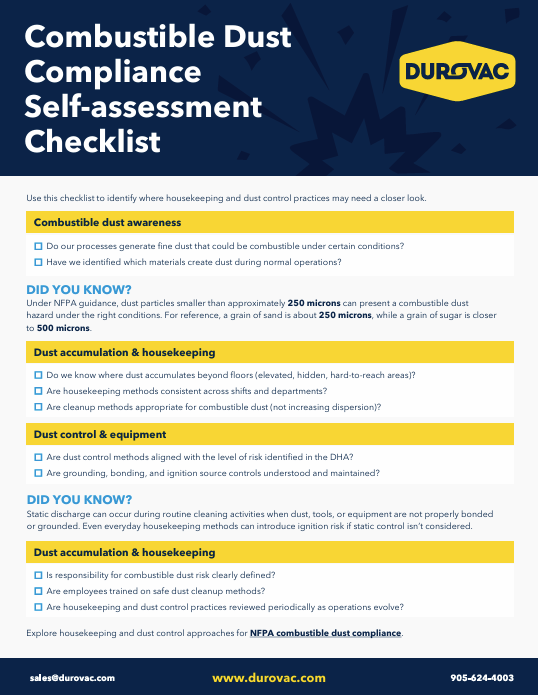
Download our combustible dust compliance checklist for a quick self-assessment of your housekeeping and dust control practices.
For the most up-to-date information on combustible dust compliance, the NFPA 660 Standard for Combustible Dusts and Particulate Solids (2025) is your main source of truth. It’s a consolidated version of six older standards on fire and explosion prevention spanning multiple industries.
It’s also a good idea to check the following standards:
As long as they’re equipped with the right features, industrial vacuum systems can function as engineering controls to improve NFPA compliance in your facility. Here’s how they do it:
Which features do you need? It depends on factors like your application and the location of dust hazards. In general, look for industrial vacs with proper grounding and bonding, filtration systems, ignition source control, and material containment.
To find NFPA compliant engineering controls for your facility, browse our suite of industrial vacuum systems.
Manufacturing is constant hard work, and it’s tempting to rely on tools like compressed air, brooms, and shovels to quickly clean a mess when it piles up. The problem with these manual methods is that from an NFPA compliance perspective, they create more risk.
First, they can’t reliably clean hard-to-reach or hidden areas, which are prime locations for combustible dust explosions. Second, they can push dust into the air and create hazardous dust clouds. Third, they don’t properly contain the dust that does get cleaned.
Only small amounts of combustible dust are required to create an explosion. With hazards that are so easy to miss, it’s essential to have engineered housekeeping solutions that integrate with your current process.
Engineering controls are meant to flow with your process. At DuroVac, we believe they should solve problems without adding new hurdles, and they should be designed to keep your whole team safe and happy.
Our vacs can be customized for any application with NFPA compliance requirements, no matter how tough the material or how big the mess. Powerful suction picks up combustible dust quickly and reliably, and tight material containment prevents dust from leaking outside of the system. Built-in safety features isolate the spread of fires and explosions.
DuroVac vacuums are also much easier to operate and maintain. In our experience, that makes for a happy team and a faster process.
To understand what an NFPA compliant vacuum looks like for your facility, get help from a knowledgeable sales engineer.
The first step is to have your material tested to see if it’s combustible. If so, the next step is a Dust Hazard Analysis (DHA). This process will help you identify and understand how to fix any fire and explosion risks in your facility, whether it’s a gap in housekeeping, uncompliant equipment, or hidden areas where dust piles up. Then you’ll need to create an action plan based on the DHA’s findings.
A dust explosion requires a combination of five factors:
This is called the Dust Explosion Pentagon. Generally, we refer to the fuel source as a combustible dust hazard. Wood, coal, flour, grain dusts, and metal dusts are common examples, but you should test your material to determine if it is combustible.
Vacuums should be customized based on factors like your application and the layout of your facility, so you can’t pick one off the shelf. Industrial vacs may need to be installed in a fixed location, located outdoors, or equipped with particular explosion protection or prevention features. To understand the type of vac you’ll need for safety and NFPA compliance, it’s best to speak with an expert.
There is no such thing as NFPA certification for industrial vacuum systems. The NFPA lists requirements for vacuums and other equipment, such as venting and explosion protection features, and it’s your supplier’s responsibility to explain how their solutions meet those requirements. When in doubt, don’t hesitate to ask.
Compressed air is actually prohibited by many regulations, and you may be fined by authorities such as OSHA and CCOHS for using it. That’s because compressed air doesn’t remove a combustible dust hazard — it just pushes it into another area of your facility. Self-contained engineering controls are the best way to prevent those hazards.
Unfortunately, no. No matter how much you clean, manual methods like sweeping can actually increase the risk of combustible dust explosions, because they don’t clean thoroughly and create flyaway dust that can settle in other areas of your facility. To prevent that, NFPA standards call for an engineered, self-contained system.